Breathplay
Breathplay is neither Safe, nor Sane and a lot of talk and trust is needed to make it Consensual.
That makes it a no-go in any "normal" BDSM context.
But studies show that half of young adults have been strangled by a partner.
Get help if needed. Find hotlines HERE.
There are three main kinds of practices:
- Controlling your breath, commonly used in diving, meditation and relaxation
- Cutting off blood supply, usually by choking a partner.
- Restricting or cutting off air supply (corsett, smothering, bagging, gas masks)
Please note that strangulation without constant supervision has a high risk of side effects, commonly including death.
Breathplay can never be done without side effects. Some practices are safer and others are riskier.
Education is key to reducing the negative and unintended consequences.
Preparation
Do not panic as a dom.
Free up all airways if the sub passes out and release any pressure immediately if a body part discolours.
Check if the sub is still breathing, do CPR and call emergency services if the breathing reflex has stopped.
Stay calm and care for the sub, aftercare is important no matter how the scene ended.
Have a drink and something to keep their blood sugar up ready, it is a lot of stress on the body.
Talk with your partner as equals, do not choke without talking about it first, as it can lead to panic attacks.
Be mindful and make small steps. A common hard limit is having things around their neck or even bagging.
Talking can be hard. Have non-verbal safe words.
Tapping out can be used, only choking while the partner holds and presses your hand is a good option.
Other options are holding a chain up and letting go when you are at your limit, kissing or even just cuddling can be used as a signal.
Effects
Most people practice it for the positive side effects.
The practise has an inherent power dynamic and that can be very arousing for some partners.
Having less oxygen can make the receiving side disoriented and feel helpless.
Giving up control and feeling helpless can lead to a fight or flight response. A surprise choking can ruin an evening.
Some like it and it can push them into a cosy headspace.
Having reduced oxygen in the head makes the receiving person feel lightheaded, often slightly disoriented, helpless and relaxed.
The mix of feeling differs on the person and how much the oxygen intake is reduced. Choking is very immediate, restricting air supply is more gradual and can be more relaxing.
The rush of blood into the brain when releasing a choke can give an almost primal rush of endorphins for surviving.
Choking can reduce blood flow immediately, see here for details.
I quote:
- Between 30-180 seconds of oxygen deprivation, you may lose consciousness.
- At the one-minute mark, brain cells begin dying.
- At three minutes, neurons suffer more extensive damage, and lasting brain damage becomes more likely.
- At five minutes, death becomes imminent.
- At 10 minutes, even if the brain remains alive, a coma and lasting brain damage are almost inevitable.
- At 15 minutes, survival becomes nearly impossible.
Applying pressure to the neck can damage the larynx, cause nerve damage or strain lymph nodes. Get to know the anatomy, be careful and read more below.
Methods for reducing air intake are not as severe and have their individual time frame.
Choking can lead to vomiting, always have a fast way to release pressure, open gags and free up airways if that happens.
Anatomie of the Neck
The most import part first:
- Do not apply pressure in the middle. Collapsing the larynx can lead to a painfull death.
- Apply pressure to the sides in the lowwer third of the neck to reduce blood flow.
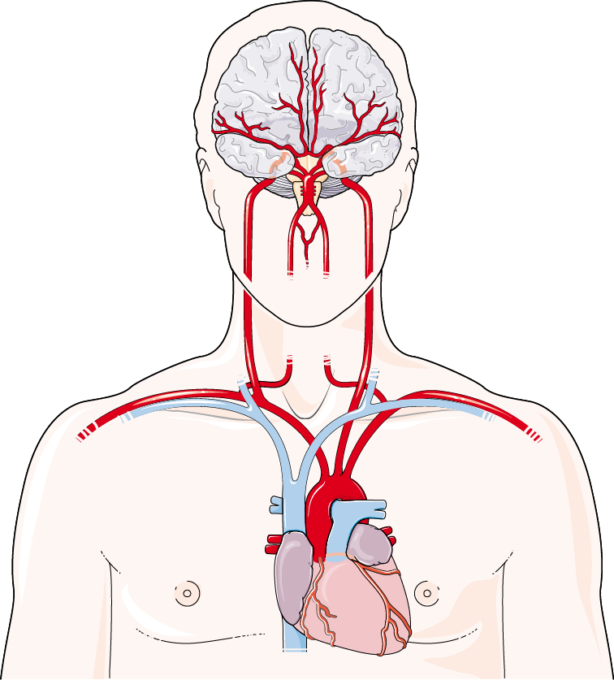
Source: https://smart.servier.com/
Take time to read up on the anatomy
Avoid applying pressure to the upper part of the neck, as the Vagus Nerve is vulnerable there.
Literature warns that overstimulation can have impacts on the heart rate, blood pressure and in rare cases result in death
Um den zu vermeiden wird vorallem im unteren drittel gedrückt.
The neck area has many lymph nodes. They are usually not noticable by touch.
You might be able to feel them when they are swollen, thats normal when the immune system is active.
Slow down and talk with the recieving person if it is a supprise.
Putting pressure on them while swollen is a bad kind of pain.
They can swell up to 2cm. Contact a doctor or a non emergency health line if they are hard or 1 to 2 weeks.